Most LED displays are flat. And flat works perfectly well for most events.
But every now and then a project comes along where flat just isn’t the right answer. The space has curves. The creative brief demands something a rectangle can’t deliver. A brand wants a display that nobody has seen before at any other event.
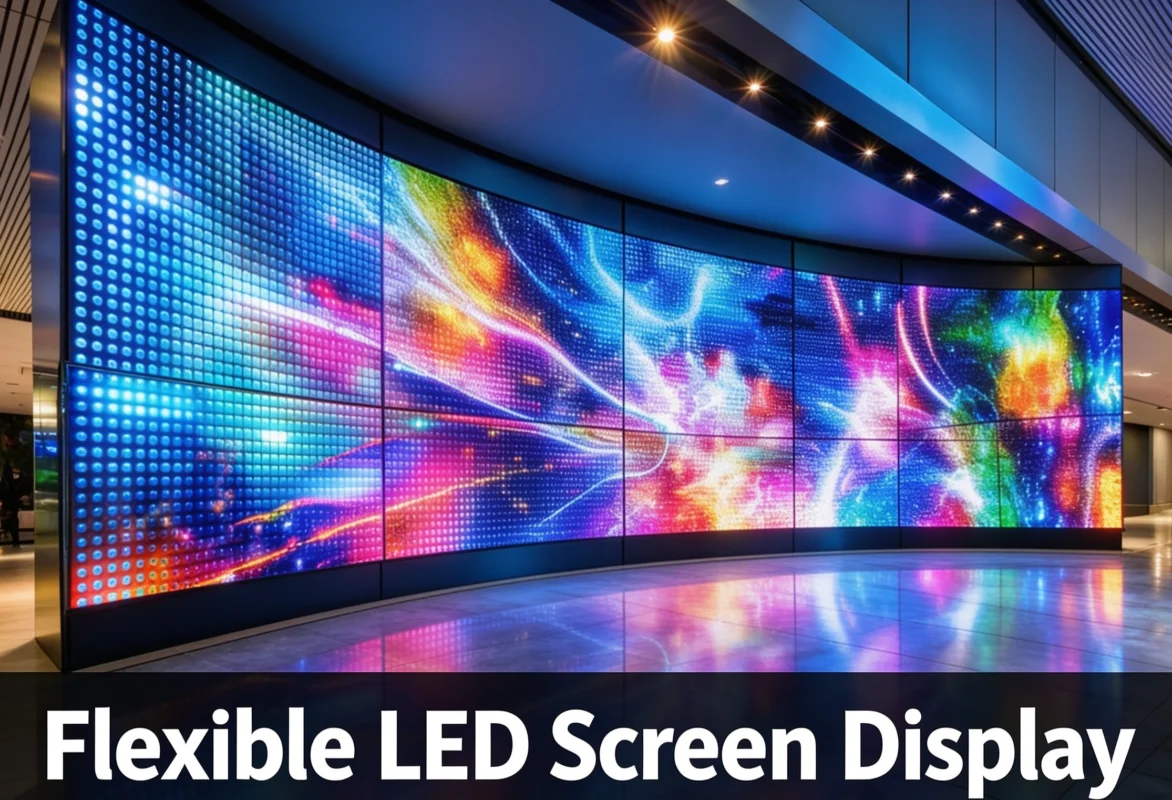
That’s where a flexible LED screen display changes everything. And once you’ve seen what one does to a space — how it turns something ordinary into something genuinely striking — it’s hard to go back to thinking about screens as just rectangles.
In this guide, therefore, we cover what flexible LED screen displays are, where they work best, and what to think about before you book one.
What Is a Flexible LED Screen Display?
How It Actually Works
A standard LED panel sits on a rigid aluminium frame. It’s flat and it stays flat. A flexible LED screen display, on the other hand, mounts its LED modules on a soft bendable base — typically silicone or flexible PCB material — that allows the display to curve, wrap, and shape itself around almost any surface.
The LED technology is identical to a standard display. As a result, you still get the same brightness, the same colour accuracy, and the same seamless image quality. The only difference is that the display no longer needs to live in a flat plane.
How Flexible Is It Really?
Most flexible LED modules achieve a minimum bend radius of around 500mm to 1,000mm. In other words, they wrap comfortably around medium-sized columns, create smooth arcs across wide backdrops, and follow gentle curves in architectural features. For very tight curves, however, we’ll always confirm what’s achievable before quoting rather than promising something the product can’t deliver.
Where Flexible LED Screen Displays Work Best
| Application | Why It Works | Typical Setup |
|---|---|---|
| Column Wraps | Follows cylindrical column surface | Full or partial column wrap |
| Curved Stage Backdrops | Creates immersive arc behind performers | Wide gentle curve |
| DJ Booth Fronts | Wraps around curved booth fascia | Concave or convex curve |
| Product Reveal Surrounds | Wraps around product for dramatic effect | Custom shaped surround |
| Retail Curved Installations | Follows curved walls or display fixtures | Architectural curve |
| Circular Centrepieces | Creates cylindrical display | Full wraparound configuration |
Brand Activations
Brand activations are honestly where flexible LED screen displays deliver the strongest impact. The whole point of a brand activation is to create a moment that people stop for, photograph, and share. A curved or cylindrical LED display running dynamic brand content does exactly that — it’s visually different, unexpected, and gives people something worth capturing on camera.
Furthermore, when someone posts a video of a curved LED display wrapping around a centrepiece structure, that content travels well beyond the event itself. That kind of organic reach is worth considerably more than the cost of the display.
Stages and Live Productions
On a concert stage or live production set, a flexible LED screen display adds something flat panels simply can’t achieve. A curved backdrop that wraps slightly around the performer creates depth and a sense of being surrounded by the show. Similarly, flexible LED elements along stage edges or around set pieces add visual texture that lifts the overall production design considerably.
Flexible LED vs Standard LED
| Feature | Standard LED Display | Flexible LED Screen |
|---|---|---|
| Shape | Fixed flat rectangle | Curves, bends, wraps |
| Pixel Pitch | P2 – P10 | P3 – P6 typically |
| Setup | Straightforward grid | Custom support structure |
| Cost | More cost effective | Higher due to custom build |
| Best For | Stages, backdrops, walls | Columns, curves, shaped sets |
Be Honest About Whether You Need It
If a flat display achieves what you need — use a flat display. Standard LED panels are more widely available, easier to set up, and more cost effective. Flexible LED is the right choice when the shape of the space genuinely demands it or when the creative brief calls for something a flat screen simply cannot deliver.
Not sure which fits your event? In that case, our pages on LED wall display screen rental and custom video wall solutions cover the full range of display options and might help you decide before you get in touch.
Content Design — Don’t Overlook This
This is where people get caught out more than anywhere else. Standard widescreen content doesn’t translate directly onto a curved display. Content that looks perfect on a rectangle can appear stretched or awkward when it wraps around a curve. Text that reads clearly on a flat surface sometimes becomes hard to follow when it bends around a column.
Good content for a flexible LED screen display works with the curve from the very beginning — using the shape as part of the design rather than fighting against it. Therefore, always factor content design into your planning timeline. It takes longer than standard content and needs a designer who understands the format. Flag it early when you get in touch and we’ll advise on exactly what’s needed.
Practical Things to Sort Before You Book
- Define the shape clearly — what exactly is the display wrapping around? The more detail you give us, the more accurate the quote
- Confirm the bend radius — tell us the tightest curve you need and we’ll confirm whether the product achieves it
- Allow extra build time — flexible installs take longer than flat walls; always factor additional setup time in
- Content lead time — curved content needs more design prep; don’t leave it to the final week before your event
- Viewing angles — curved displays have narrower sweet spots; think carefully about where your audience will stand
- Power access — flexible installs often go in unusual spots; confirm power is accessible nearby before you commit to a location
Frequently Asked Questions
Is flexible LED more expensive than standard LED?
Generally yes — the modules cost more, the custom support structure adds to the build, and installation takes longer. That said, for the right event the visual impact more than justifies the investment. If budget is tight, we’ll always tell you honestly whether a standard display achieves something similar at lower cost.
Can flexible LED displays be used outdoors?
Yes, with the right product. Not all flexible modules carry weatherproofing so always specify outdoor use from the very start. We’ll confirm what outdoor-rated options are available for your specific setup before anything gets finalised.
Can I combine flexible and standard LED in the same installation?
Absolutely — and in fact this is a very common and effective approach. A standard flat LED wall display screen as the main backdrop combined with flexible LED elements on stage edges creates a visually interesting setup that uses each product where it performs best.
How do I know if my space suits a flexible LED display?
Simply describe the space to us — the structure you want to wrap, the curve you’re trying to follow, the overall size. We’ll tell you honestly whether flexible LED is the right solution or whether a different approach works better.
Do you handle content design as well as the hardware?
We manage the full technical setup. For content design specifically, we can point you towards the right creative partners if needed. Just flag it early so there’s enough lead time before your event.
Ready to Go Beyond the Flat Screen?
If you have a space that doesn’t suit a rectangle, a creative brief that demands something different, or simply a vision for something nobody has seen before — the conversation starts here.
Tell us the shape you’re going for, the venue, the event date, and what you want to display. We’ll come back with honest advice and a clear quote — no hard sell, no hidden costs.
Follow us on Facebook to see recent flexible LED installations before you reach out.
LED Alliance
- 🌐 led-alliance.com
- 📞 +1 310-467-5765
- 📧 steff.jones@productionzync.com
- 📍 13550 Village Park Dr, Suite 310, Orlando, FL 32837