Most people think of LED screens as flat rectangles. A wall of panels behind a stage, a display board at a conference, a screen in a lobby. And honestly — flat works for a lot of events.
But sometimes flat simply isn’t enough.
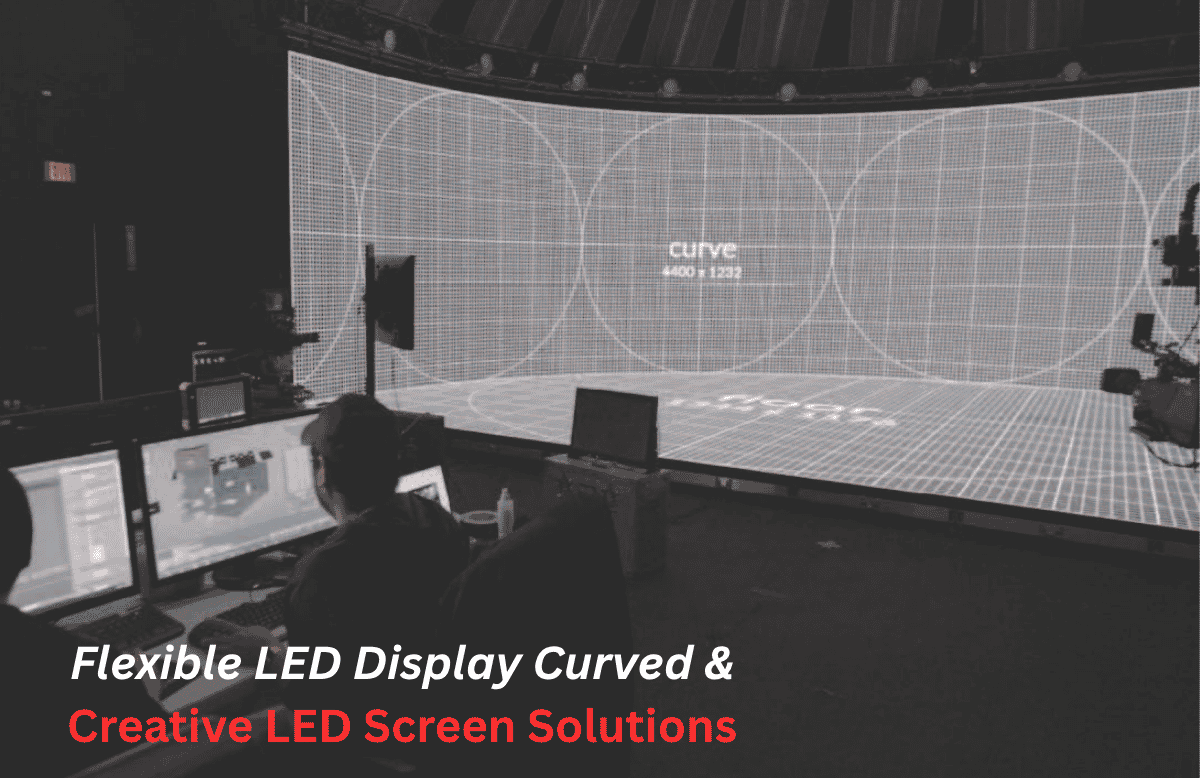
Sometimes you need a display that wraps around a column. Or curves across the front of a DJ booth. Or bends into an arc above a brand activation space. That’s exactly where flexible LED display comes in. And once you’ve seen what it does to a space — how it transforms something ordinary into something genuinely eye-catching — it’s hard to go back to thinking about screens as just rectangles.
In this guide, we cover everything you need to know about flexible LED display rental. What it is, where it works best, how it differs from standard LED, and what to sort out before you book.
What Is a Flexible LED Display?
The Technology in Plain English
A flexible LED display is built on a soft bendable substrate — usually silicone or flexible PCB material — instead of a rigid aluminium frame. Because of this, the screen can curve, wrap, and shape itself around almost any surface or structure.
The LEDs themselves are the same technology you’d find in a standard display. So you still get the same brightness, the same colour accuracy, and the same seamless image quality. The only difference is the form — it’s no longer locked into a flat plane.
How Flexible Is It Really?
It depends on the product. For example, some flexible LED modules curve to a radius of around 500mm — tight enough to wrap around a column or cylindrical stage structure. Others, however, handle gentler curves — a wide arc across a backdrop rather than a full wraparound.
We’ll always tell you what’s achievable with the specific product we’re supplying. Simply describe the shape you have in mind and we’ll tell you honestly whether it’s doable.
Where Flexible LED Displays Work Best
Events and Experiential Marketing
| Application | Why It Works | Typical Setup |
|---|---|---|
| Brand Activations | Creates unique shareable moments | Curved or cylindrical display |
| DJ Booths & Stages | Wraps around booth front or stage fascia | Concave or convex curve |
| Exhibition Stands | Stands out among flat screens on show floor | Arched or angled display |
| Product Launches | Wraps around product for dramatic reveal | Custom shaped surround |
| Retail Installations | Follows curved walls or display fixtures | Column wrap or curved wall |
| Permanent Venues | Follows architectural features in lobbies | Wide gentle arc |
When Flat Simply Won’t Work
Curved walls, cylindrical columns, circular stages, irregular structures — these are exactly the situations where flexible LED earns its place. In other words, if the architecture of your venue is working against a standard rectangular screen, a flexible display is usually the most elegant solution available.
Flexible LED vs Standard LED — Key Differences
| Feature | Standard LED Panel | Flexible LED Display |
|---|---|---|
| Shape | Fixed rectangle | Curves, bends, wraps |
| Installation | Modular grid build | Follows custom structures |
| Pixel Pitch | P2 – P10 | P3 – P6 typically |
| Best For | Stages, backdrops, walls | Columns, curved sets, shapes |
| Setup Complexity | Straightforward grid | Requires custom rigging plan |
So Which One Should You Choose?
If a flat display works for your event — use a flat display. Standard LED panels are more widely available and, as a result, typically more cost-effective. Flexible LED, on the other hand, is the right call when the shape of the space demands it or when you want to create something visually distinctive that a flat screen simply can’t achieve.
Not sure which fits your event? In that case our guides on LED screen rental and LED video display board rental cover standard format options in detail and might help you decide before you get in touch.
What to Know Before You Book
Content Needs to Be Designed for the Curve
This catches people out more than anything else. Content that looks great on a flat screen can, for instance, look distorted across a curve. Similarly, text that reads perfectly on a rectangle becomes awkward when it wraps around a column.
Good content for a flexible LED display works with the curve — it uses the shape as part of the design rather than fighting against it. Therefore, flag this early when you get in touch and we’ll talk through what works best for your configuration.
The Rigging Plan Matters More Than You Think
A flexible display needs a custom support structure that holds the curve in exactly the right position and keeps it there throughout your event. As a result, we design this as part of the rental package — not something we figure out on the day. Additionally, a site visit beforehand is almost always worth doing for flexible installs to avoid any surprises during load-in.
Practical Things Worth Sorting Early
- Know your structure — what is the display wrapping around? For example, a column, set piece, or curved wall?
- Consider the viewing angle — because curved displays have narrower sweet spots, think carefully about where your audience stands
- Allow content lead time — since curved content needs more design prep than flat, don’t leave it to the last week
- Confirm power access — flexible installs are often in unusual spots, so make sure power is nearby before committing to a location
- Factor in build time — flexible installs take longer than flat walls, therefore always allow extra setup time in your venue access window
Frequently Asked Questions
Can flexible LED be used outdoors? Yes, however not all flexible modules are weatherproofed. That’s why it’s important to always specify outdoor use from the start. We’ll confirm what’s available and suitable for your specific configuration before anything is confirmed.
Is flexible LED more expensive than standard LED? Generally yes — because the modules cost more, the rigging requires additional custom work, and the install takes longer. That said, if budget is a concern we’ll always tell you honestly whether a standard display could achieve something similar at a lower cost.
What content format works best? MP4 for video, PNG or JPEG for static content — same as standard LED. However, the key difference is that content should be designed with the curve in mind from the very start. We’ll advise on resolution and aspect ratio once we know the exact configuration.
Can I see examples before I book? Absolutely. For example, you can follow us on Facebook for photos and video from recent installs. Alternatively get in touch directly and we’ll share relevant examples from previous projects.
Do you handle event lighting alongside the flexible display? Yes — and furthermore, combining the two is where things get really interesting. A curved LED display with matched event lighting creates something genuinely impressive. Because we handle both in-house, we design them to work together from the very start.
Let’s Talk About Your Project
So if you’ve got a shape in mind, a venue booked, and an event coming up — the next step is simple. Tell us the date, the venue, what you’re wrapping the display around, and what you want to show on it. As a result, we’ll come back with honest advice and a clear itemised quote.
No hard sell. No call centres. Just a straightforward conversation with people who know this equipment inside out.
LED Alliance
- 🌐 led-alliance.com
- 📞 +1 310-467-5765
- 📧 steff.jones@productionzync.com
- 📍 13550 Village Park Dr, Suite 310, Orlando, FL 32837