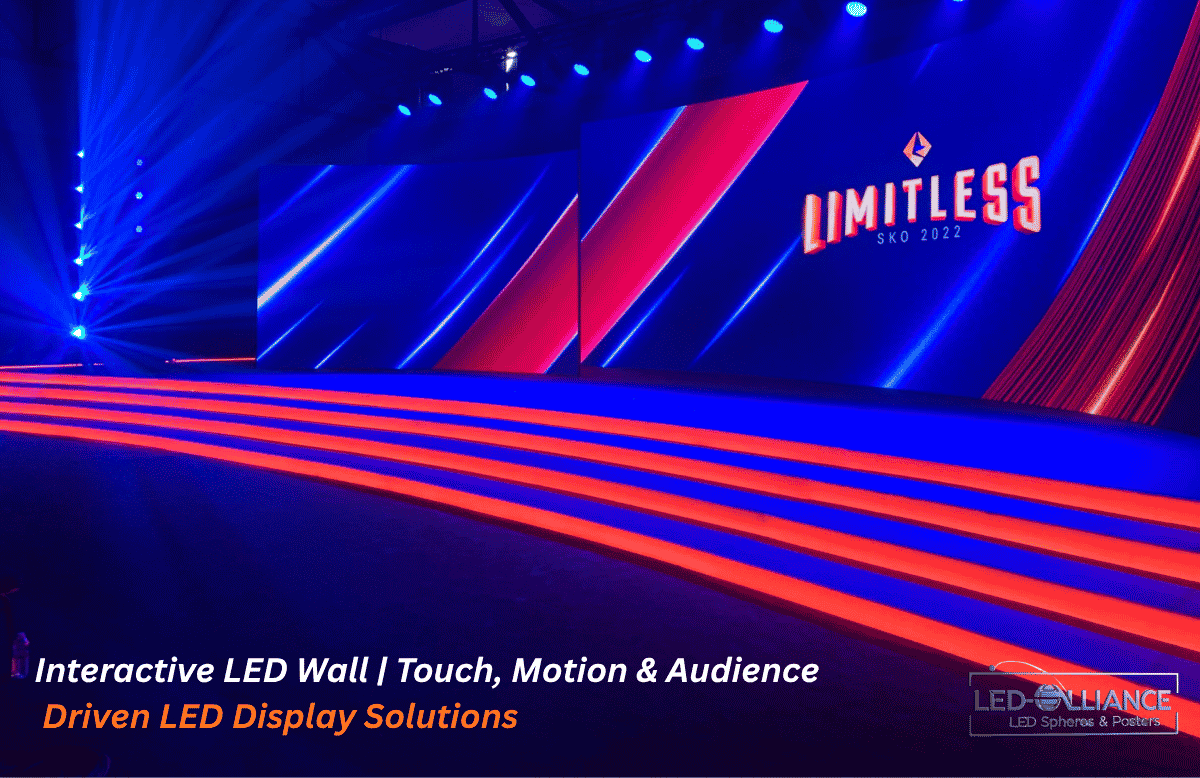
There’s a fundamental difference between an audience that watches an event and an audience that participates in one. Passive audiences sit, observe, and forget. Participating audiences engage, respond, and remember. And increasingly, the tool that makes the difference between those two experiences is an interactive LED wall.
Not just a display that shows content — but one that reacts to the people in front of it. That responds to touch, to movement, to sound. That turns a room full of spectators into active participants in whatever is happening on stage or at a brand activation space.
This page covers everything you need to know about interactive LED wall solutions — how the technology works, where it performs best, what’s involved in setting one up, and whether it’s the right choice for your event.
What Is an Interactive LED Wall?
Beyond Passive Display
A standard LED wall displays content. An interactive LED wall responds to it — or more accurately, responds to the people standing in front of it. The display changes, reacts, and evolves based on real-time input from the audience or environment around it.
That input can come from several different sources depending on the technology being used. In each case, however, the result is the same — a display that feels alive rather than static, and an audience that feels involved rather than ignored.
Types of Interaction Technology
| Interaction Type | How It Works | Best For |
|---|---|---|
| Touch Interactive | Audience touches screen surface to trigger content | Exhibitions, retail, trade shows |
| Motion Sensor | Camera or sensor detects movement and responds | Brand activations, experiential events |
| Audience Response | Live polling or voting displayed in real time | Conferences, corporate events |
| Social Media Integration | Live social feeds and hashtag content displayed | Concerts, festivals, brand launches |
| Gesture Control | Hand movements control display content | Product launches, interactive demos |
| Sound Reactive | Audio input drives visual response on screen | Concerts, DJ events, nightlife |
Why It Works So Well
The reason interactive LED walls generate such strong audience engagement is straightforward — people are naturally drawn to things that respond to them. When someone waves their hand and the display changes, or when they see their social media post appear on a giant screen, there’s an immediate emotional reaction. Furthermore, that reaction almost always leads to a phone coming out and a video being recorded — which extends the event’s reach far beyond the people physically in the room.
Where Interactive LED Walls Work Best
Brand Activations and Experiential Marketing
This is honestly where interactive LED walls deliver the strongest return. A brand activation exists to create a moment that people talk about, photograph, and share. An interactive display that responds to audience movement or touch does exactly that — it gives people something to do, something to experience, and something worth capturing on camera.
Moreover, the data collected through interactive displays — how many people engaged, what content they interacted with, how long they spent at the display — gives brands genuinely useful insight into audience behaviour that a passive display simply can’t provide.
Trade Shows and Exhibitions
On a busy trade show floor, standing out is everything. An interactive LED wall draws people in naturally — because curiosity is a powerful force and a display that visibly responds to people nearby is almost impossible to walk past without stopping.
Additionally, for product demonstrations especially, touch-interactive displays allow visitors to explore product information, features, and specifications at their own pace rather than waiting for a sales presentation. As a result, stands with interactive displays consistently report higher dwell time and more meaningful conversations with visitors.
Corporate Conferences and Events
Interactive elements at corporate events — live audience polling displayed in real time on a large LED wall, social media walls running event hashtag content, real-time data visualisations — transform the dynamic between presenter and audience. Instead of a one-way presentation, the event becomes a conversation. Furthermore, audience response data collected during the event provides useful post-event analytics for organisers.
Concerts and Live Music Events
Sound-reactive LED walls that pulse and shift with the music, social media walls displaying fan content in real time, audience-driven visual experiences triggered by crowd noise — these elements add a layer of participation to live music events that goes well beyond what a standard video wall achieves.
What’s Involved in Setting Up an Interactive LED Wall
The Technical Side in Plain English
An interactive LED wall involves more technology than a standard display — and therefore requires more planning. In addition to the LED panels themselves, an interactive setup typically involves sensors or cameras, a real-time processing system that interprets the input and generates the visual response, and software that manages the content and interaction logic.
At LED Alliance, we manage all of this. The technical setup, the software configuration, the sensor positioning, and the content integration — all handled by our team so you don’t need to understand the technology to benefit from it.
Content Design for Interactive Displays
This is worth emphasising because it’s something people underestimate. Interactive content isn’t the same as standard display content. It needs to be designed with the interaction in mind from the very beginning — what triggers what, how the display transitions between states, what the audience sees before they interact versus during and after.
Good interactive content design makes the experience feel intuitive and impressive. Poor interactive content design makes it feel confusing and underwhelming — regardless of how good the underlying technology is. Therefore, always factor content design into your planning timeline and budget for an interactive LED wall project.
Practical Things to Sort Before You Book
- Define the interaction type early — touch, motion, social, sound reactive — each requires different technology and setup
- Consider the audience journey — how will people discover the display is interactive? Make it obvious
- Content design lead time — interactive content takes longer to develop than standard content; allow extra time
- Space around the display — motion and gesture interactive walls need clear space in front of them to work properly
- Data and privacy — if collecting audience interaction data, ensure you have appropriate consent and privacy considerations in place
- Testing time — interactive systems need thorough testing before the event; always allow time for a full run-through
Frequently Asked Questions
How reliable are interactive LED walls at live events? Very reliable when properly set up and tested beforehand. The key is thorough pre-event testing and having a technician on site throughout the event who can respond immediately if anything needs adjusting. We include both as standard in every interactive LED wall rental.
Can the interactive display be customised to our brand? Yes — completely. The content, the colour palette, the interaction triggers, the visual responses — all of it is built around your brand identity and event objectives. In fact, brand customisation is one of the most important parts of the design process for interactive displays.
How much space does an interactive LED wall need? It depends on the interaction type. A touch interactive display needs people to stand close — within arm’s reach. A motion or gesture interactive wall, on the other hand, needs clear space of two to four metres in front of the display for the sensors to work properly. We’ll advise on space requirements when we design your setup.
Can interactive elements be combined with a standard video wall? Yes. A common and effective approach is to use a standard custom video wall as the main display and incorporate an interactive element — a touch panel, a motion sensor zone, or a social media feed — as a secondary feature within the overall display design.
Do you handle the software and content side as well as the hardware? We manage the full technical setup including hardware, software configuration, and sensor integration. For content design and development, we can connect you with the right creative partners if needed — just flag it early so there’s enough time before your event.
Ready to Create Something Your Audience Will Actually Remember?
Because that’s really what an interactive LED wall comes down to. Not just a display — an experience. Something people engage with, photograph, share, and talk about long after the event is over.
If that sounds like what your event needs, the conversation starts simply. Tell us your event date, venue, audience size, and what kind of interaction you’re looking to create. We’ll come back with honest advice and a clear quote.
Follow us on Facebook to see recent interactive and experiential LED setups — it’s a good way to get a feel for what’s possible before you reach out. Contact us